
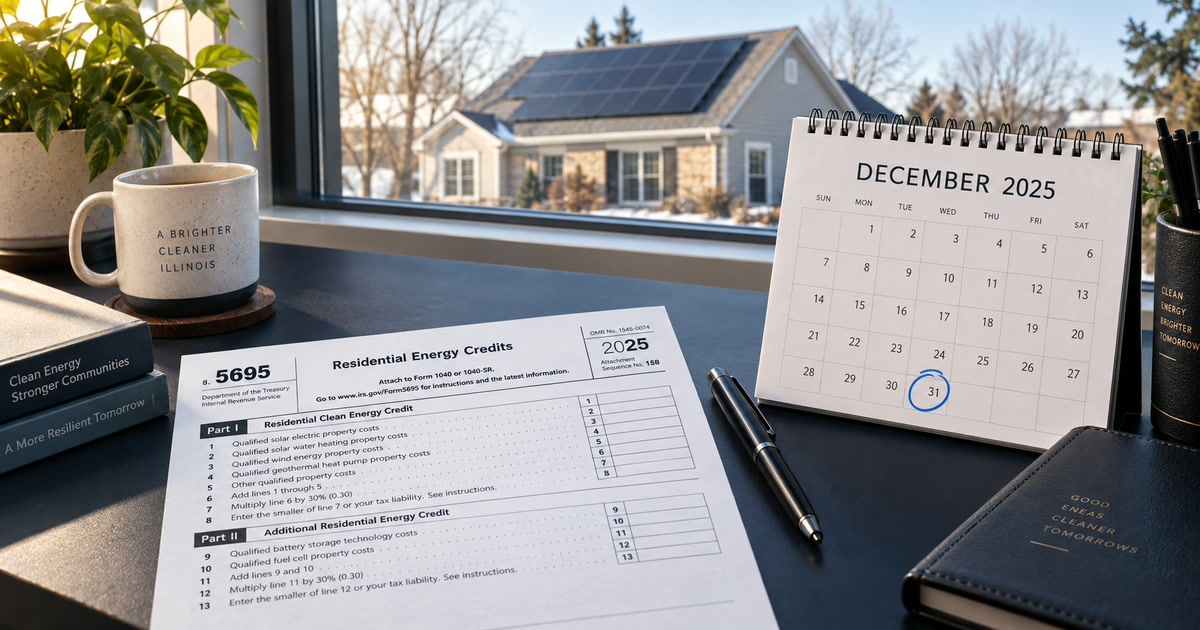
In late October 2025, imagine a homeowner in Plainfield signing with a solar company that promises a 30% federal tax credit, only to watch the installation date slide from December into February. When she calls to ask whether the credit still applies, the salesperson says the credit is based on the signing date. It is not. Her installation is completed in 2026, the credit is gone, and roughly $7,000 she had counted on never shows up. The question people are typing into Google, is the solar tax credit going away, has a clear answer now, and it is more complicated than yes or no, so this is the full picture as it stands in 2026.
The short version
The 30% federal credit for homeowners who buy solar, known as the Residential Clean Energy Credit under Section 25D of the tax code, ended for qualifying expenditures made after December 31, 2025. Under IRS rules, that generally means a system whose original installation was completed in 2026 receives no new Section 25D credit, whether paid for with cash or a loan. There was no step-down or signing-date grace period. Read the IRS guidance.
A different credit, the commercial Clean Electricity Investment Credit under Section 48E, survived for eligible business-owned systems. That can include the companies behind residential leases and power purchase agreements. For applicable solar facilities whose construction began after July 4, 2026, the current law generally requires the system to be placed in service by December 31, 2027. The company claims the credit, not the homeowner, and any value reflected in the customer's price depends on the provider, project eligibility, and contract.
So the credit is not entirely gone. It moved, and that move reshaped how solar gets bought in Illinois.
What the law actually did
The change came from Public Law 119-21, commonly called the One Big Beautiful Bill Act, signed on July 4, 2025. Under the previous law, the Inflation Reduction Act of 2022, the residential credit was set at 30% through 2032 and then scheduled to step down before ending. The 2025 law cancelled that schedule and set a hard termination date after December 31, 2025, years earlier than previously planned.
The date that matters is generally when the original installation is completed, not when the agreement is signed or a deposit is paid. That is the detail that caught homeowners whose projects slipped past the deadline.
Homeowners whose installations were completed by the end of 2025 may still claim the credit if they otherwise qualify. It is claimed on IRS Form 5695 with the 2025 return, and the 2025 Form 5695 instructions explain how unused residential clean-energy credit carryforwards can continue into 2026.
Home batteries followed the same Section 25D deadline when bought and owned by the homeowner. A battery owned by a leasing company as part of a business-owned project is a separate case and requires project-specific tax analysis.
The credit survived for leases, and that changes the math
Section 48E is a business credit. When a homeowner signs a lease or a power purchase agreement, a company owns the panels on the roof, and an eligible system owner may claim the commercial credit. The law generally terminates Section 48E for applicable solar facilities placed in service after December 31, 2027 when construction begins after July 4, 2026. Projects that began construction on or before that transition date can fall under different rules, as explained in IRS Notice 2025-42.
The result is a situation that would have sounded backward two years ago. In 2026, an eligible leased or PPA system in Illinois may carry a federal business incentive while a newly purchased homeowner-owned system does not. That does not automatically make leasing the better choice. The credit belongs to the company, how much value reaches the homeowner depends on the terms, and the contract determines who owns the Illinois Shines REC value. It does mean the buy-versus-lease question needs fresh math, which our lease versus buy guide works through in detail.
What Illinois did in response
Illinois did not sit still. For the 2026-27 program year, the Illinois Power Agency added a $20-per-REC adder under Illinois Shines for qualifying customer-owned Small DG systems that are not receiving a federal credit. On an illustrative 7.5 kW system, that adder can be worth roughly $2,700 over the fifteen-year REC agreement, depending on approved production and program eligibility, on top of the base REC value. Our Illinois Shines explainer covers how the program, Disclosure Form, and payment schedule work, and Illinois Shines explains the 2026-27 change.
Qualifying ComEd and Ameren smart inverter rebates may also be available, and net-billing credits continue under current utility rules. Our ComEd rebate guide explains that program. These programs do not recreate the old 30% homeowner credit dollar for dollar, but they can close part of the gap. They also work differently from a tax credit, so eligibility, customer value, and timing should be confirmed in the project documents instead of assumed from a headline number.
How to spot an outdated pitch
Any quote for a newly purchased homeowner system in 2026 that subtracts a new 30% Section 25D credit deserves immediate correction. The same goes for a salesperson who says the credit was locked in by the signing date. Many websites still list Illinois solar prices “after the 30% federal credit” even though those examples no longer apply to new homeowner-owned installations completed in 2026.
A lease or PPA pitch that mentions a federal business credit can be legitimate, but ask the follow-up question: how much of that value is reflected in my pricing, who owns the RECs, and what happens if the system owner does not qualify as expected?
What this means for your decision
The federal credit made a good investment better. Losing it can lengthen the investment timeline without automatically making the project bad. Illinois results now depend even more heavily on the installed price, roof production, utility, daytime usage, export credits, financing, current program eligibility, and the exact customer value disclosed through Illinois Shines.
We walk through those variables in our article on whether solar is worth it in Illinois and in our Illinois solar cost guide.
For a homeowner who wants to own the system, buying can still work, and the $20 REC adder was created specifically to support qualifying customer-owned projects without a federal credit. For a homeowner who wants little or no upfront cost and accepts third-party ownership, an eligible lease or PPA may capture a federal business incentive under the current transition rules. Neither path wins automatically.
We help Illinois homeowners run both scenarios against their actual bill and roof. If you want to see which one comes out ahead for your house under the 2026 rules, schedule a free consultation and bring a recent ComEd or Ameren bill.
Program and tax information checked September 21, 2026. This article is general educational information, not tax, legal, or financial advice. Eligibility and tax treatment depend on the taxpayer, system owner, project, contract, construction timing, and current law. Consult a qualified tax professional before relying on a federal credit.
Frequently asked questions
Is the solar tax credit going away?
The residential credit already went away. The 30% credit under Section 25D ended for qualifying expenditures made after December 31, 2025, with no phase-down. A separate commercial credit under Section 48E may still apply to eligible leased and PPA systems under the current federal deadlines.
Can I still get the 30% solar tax credit in 2026?
Not on a new system you buy with cash or a loan. If you sign a lease or a power purchase agreement, the company that owns an eligible system may qualify for the commercial credit and may reflect part of that value in its pricing. You do not claim that business credit on your own return.
Does the tax credit depend on when I signed or when the system was installed?
For Section 25D, the IRS generally treats the expenditure as made when the original installation is completed. Paying a deposit or signing in 2025 did not preserve the credit if installation was completed after December 31, 2025.
What incentives are left for buying solar in Illinois in 2026?
Potential programs include Illinois Shines REC value, a $20-per-REC adder for qualifying customer-owned Small DG projects not receiving a federal credit, qualifying ComEd or Ameren smart inverter rebates, and net-billing credits. Eligibility, value, timing, and customer benefit depend on the project and current program terms.
Will the lease and PPA credit go away too?
Section 48E generally terminates for applicable solar facilities placed in service after December 31, 2027 when construction begins after July 4, 2026. Earlier-started projects can fall under different transition rules, so the system owner must confirm eligibility for the specific project.