
Imagine a couple in Elgin comparing three solar quotes this spring: one for $19,800, one for $31,500, and one for $0 down with a monthly payment that never quite adds up to a total. All three are for roughly the same roof. In this illustrative example, the problem is not necessarily that anyone is lying. It is that nobody has put the numbers on the same footing, and one quote still subtracts a federal tax credit that is no longer available for a new homeowner-owned installation. If you are trying to figure out solar panel cost in Illinois in 2026, the first job is learning how to read a quote, so that is where this starts.
What solar panels cost in Illinois in 2026
The number that lets you compare any two quotes is price per watt installed, before incentives. It takes the total system price and divides it by the system's size in watts, which strips out the difference between a 6 kW quote and a 10 kW quote so you can see what each company is actually charging for its work.
A useful planning range for residential solar in Illinois in 2026 is about $2.90 to $3.20 per watt installed, before incentives. EnergySage's marketplace data, updated September 4, 2026, reports an Illinois average of $2.98 per watt. Your roof, equipment, electrical work, and financing can put an individual quote outside that range. See EnergySage's pricing data.
Put that against real system sizes and the picture looks like this. A 6 kW system, which may suit a smaller home or a household with modest usage, lands around $18,000 to $19,500 before incentives. A 7.5 kW system runs about $22,000 to $24,000. A 10 kW system for a larger house or one with an EV or electric heat comes in around $29,000 to $32,000, and a 12 kW system reaches the mid to high thirties. These are approximate planning figures, not quotes; the right size depends on your usage and expected production. Larger systems can cost less per watt because some project costs are fixed.
Those numbers include panels, inverters, racking, wiring, labor, permits, and the interconnection paperwork with ComEd or Ameren. They do not include a battery, which is a separate decision covered below. Major roof repairs or electrical upgrades can also add to the project total.
Why so many Illinois solar prices online are wrong
If you search this topic you will find pages confidently listing Illinois solar costs “after the 30% federal tax credit.” Those pages are out of date for a new homeowner-owned installation. The federal Residential Clean Energy Credit, Section 25D, ended for systems whose installation is completed after December 31, 2025. A homeowner buying and installing a system with cash or a loan in 2026 cannot claim that credit. The IRS instructions explain the cutoff.
A qualifying third-party-owned lease or power purchase agreement may involve different business tax incentives. Those belong to the provider, not the homeowner, and eligibility or a lower monthly payment should not be assumed without checking the contract.
This matters when comparing old prices. When the full credit applied, a $24,000 eligible system could net out around $16,800 after the federal credit alone. In 2026, a purchased system has no new Section 25D discount waiting at tax time. The Illinois programs that remain work differently, so compare the gross prices first.
What actually comes off the price in Illinois
The incentives that remain are Illinois programs with separate eligibility, customer-benefit, and application rules. Two can reduce the effective cost of a qualifying purchased system, but they are not automatic discounts on every installation contract.
The first is the ComEd or Ameren smart inverter rebate, sometimes called the distributed generation rebate. Qualifying residential systems can receive $300 per kilowatt of eligible nameplate generating capacity, so a 7.5 kW system can earn $2,250 and a 10 kW system $3,000. It requires eligible equipment, interconnection, and an approved application filed with the utility. Payment timing depends on review and complete paperwork. Our ComEd rebate guide covers the timing and the paperwork.
The second is Illinois Shines. Contracting utilities purchase fifteen years of RECs from qualifying Small DG projects through Approved Vendors. For 2026-27, qualifying 0-10 kW AC projects have a base price of $70.37 per REC in Group A/Ameren and $80.77 in Group B/ComEd, with a potential $20 customer-owned Small DG adder when Program requirements are met. Those are Approved Vendor contract prices, not guaranteed homeowner payouts.
For projects on the 2026-27 Small DG payment schedule, the contracting utility pays 50% of the contract value to the Approved Vendor at energization, with the remainder paid ratably over the following six years. The customer's value and schedule depend on the Disclosure Form and agreement. Ask exactly how the value appears in your offer. Our Illinois Shines explainer covers how it works, and the program's 2026 update explains the schedule change.
Illinois also offers a special property-tax valuation for qualifying solar energy systems. Do not assume it is automatic or that your total property-tax bill cannot rise for other reasons: confirm eligibility and the application process with your county assessment office. See the Illinois property-tax guide.
A worked example for a typical Illinois home
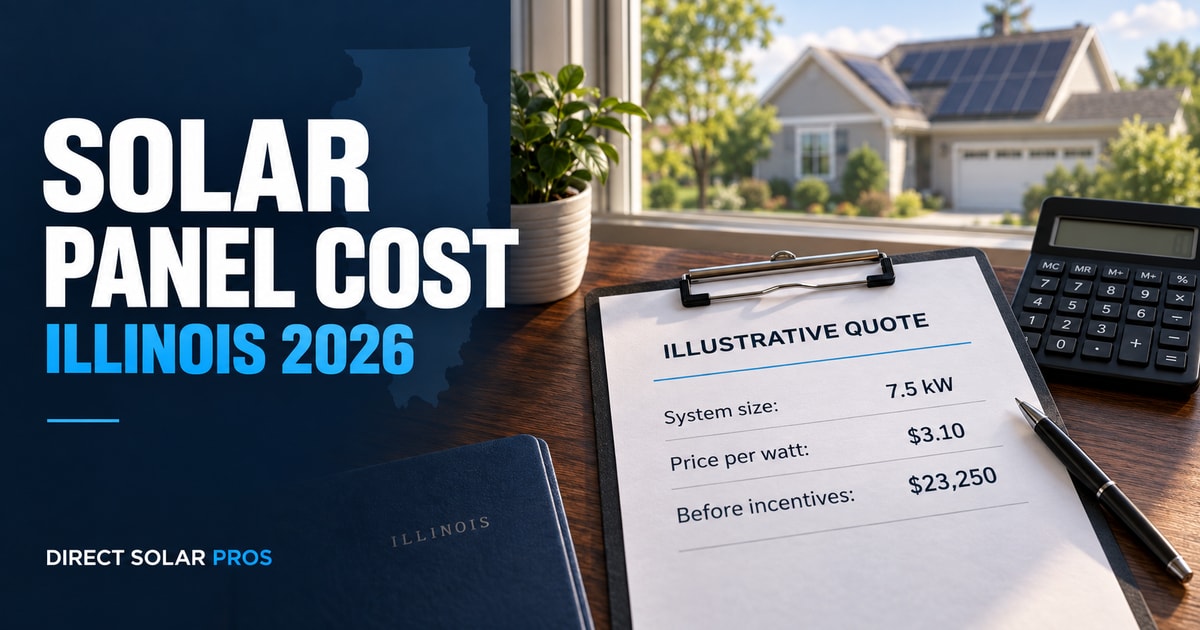
Take a 7.5 kW system at $3.10 per watt, which is $23,250 installed. If the project qualifies for a $2,250 smart inverter rebate, the arithmetic reference becomes $21,000 before considering financing, maintenance, taxes, or any customer value disclosed through Illinois Shines.
Do not subtract a generic REC headline from that number. Use the approved production estimate, applicable Group A or Group B REC price, confirmed adder eligibility, Approved Vendor terms, and the exact customer benefit stated in the Disclosure Form and agreement.
Assume that system produces about 9,000 kWh a year. Under net billing, the electricity you use directly avoids purchases from ComEd, while exported electricity generally earns a supply credit rather than the full retail rate. At an illustrative blended value of about 12 to 17 cents per generated kilowatt-hour, that is roughly $1,100 to $1,500 in first-year value. Your current tariff, daytime usage, exports, shading, and system performance determine the actual result; future utility rates can rise or fall. Our post on whether solar is worth it in Illinois walks through the full payback math.
What makes one Illinois quote higher than another
Once two quotes are converted to price per watt, the remaining gap usually comes from one of a handful of things.
Equipment is a major factor. Premium panels with higher efficiency and long product warranties can cost more per watt than standard panels. Microinverters can cost more than a basic string inverter and may help with panel-level performance on partially shaded roofs, although the best design depends on the equipment and site. Neither choice is automatically right for every house, but you should know which one you are being quoted.
Roof complexity is next. A steep roof, multiple small roof planes, tile or slate, or a roof that needs structural reinforcement adds labor. An older roof adds risk, because installing panels on a roof with limited life left can mean paying to remove and reinstall them later. A good company will discuss that before quoting.
Financing is the quiet one. Some solar loans carry substantial dealer fees baked into the quote in exchange for a lower advertised interest rate. For example, a $24,000 cash price could become a $30,000 financed price without the equipment changing at all. Always ask for the cash price alongside the financed price so you can see the difference, and compare total repayment as well as the monthly payment.
Leases and power purchase agreements can offer little or no upfront cost and a different structure entirely, which is why our lease versus buy guide treats them separately. Check escalators, ownership, and transfer terms instead of comparing the monthly payment alone.
The last factor is the sales channel. Commissions, lead acquisition, and other overhead have to be recovered somewhere and can affect the price per watt. The useful comparison is still the complete scope, equipment, service, and total cost.
Should you add a battery?
For planning, a home battery can add roughly $12,000 to $18,000 installed, depending on capacity, brand, backup capability, and electrical work. Get a separate line-item quote rather than treating that range as a fixed add-on.
Qualifying utility customers may receive a storage rebate of $300 per kilowatt-hour of eligible nameplate capacity, which would be $4,050 for 13.5 kWh. Enrollment, dispatch, tariff, and equipment requirements depend on the utility and application date. Confirm the current rules before including the rebate in your budget. See ComEd's rebate terms and Ameren's current rebate resources.
Whether it is worth it depends on two things. If you want solar-powered backup during outages, you generally need a battery and equipment designed for backup operation, since a standard grid-tied solar system shuts off when the grid goes down. A generator is another backup option, but it is not solar storage.
Under net billing, a battery also lets you store daytime production and use it at night instead of exporting it at the lower supply rate. That can improve the value of the solar energy you produce, but it does not automatically pay back the battery's purchase price. For a household that uses most of its power while the sun is up and does not need backup, the battery can be a harder financial case to make.
Getting a quote you can trust
Ask every company for the gross price and the price per watt before incentives, the specific panel and inverter models, the cash price alongside any financed price, and a written statement of what portion of the Illinois Shines REC value you receive. Any quote that still lists a new homeowner federal credit for a purchased system installed in 2026 should be sent back for clarification.
We work with homeowners across Illinois to size a system to their real usage and coordinate installation through vetted partners, and we quote in price per watt so you can hold it up against anything else you receive. Schedule a free consultation and bring a recent electric bill and any quotes you already have.
Prices and program details checked September 14, 2026. Examples are estimates, not guarantees or personal tax advice. Confirm current eligibility, payment timing, and tax treatment before signing.
Frequently asked questions
How much do solar panels cost in Illinois in 2026?
A useful planning range for installed residential solar in Illinois is about $2.90 to $3.20 per watt before incentives in 2026. A typical 7.5 kW system costs roughly $22,000 to $24,000, a 6 kW system about $18,000 to $19,500, and a 10 kW system around $29,000 to $32,000. These are approximate planning figures, not guaranteed quotes.
Is the 30% federal solar tax credit still available in Illinois?
Not for a new homeowner-purchased system installed in 2026. The federal Section 25D credit ended for installations completed after December 31, 2025. Qualifying leases and power purchase agreements may benefit from separate business tax credits on the provider’s side; eligibility and any savings passed to the homeowner depend on the project and contract.
What incentives reduce solar cost in Illinois?
Qualifying residential ComEd and Ameren customers may receive a $300-per-kilowatt smart inverter rebate. Through Illinois Shines, contracting utilities purchase RECs from qualifying projects under contracts with Approved Vendors. Eligible battery systems may receive $300 per kilowatt-hour, subject to current utility requirements. Customer value and timing depend on eligibility, the Disclosure Form, and the agreement.
How much does a 10 kW solar system cost in Illinois?
About $29,000 to $32,000 installed before incentives is a reasonable 2026 planning range. A qualifying $3,000 smart inverter rebate would reduce that arithmetic reference to $26,000 to $29,000 before considering any customer value disclosed through Illinois Shines. Final effective cost depends on the REC contract, Disclosure Form, financing, fees, and eligibility; it is not one fixed statewide after-incentive price.
Why is my solar quote higher than the average?
Premium equipment, a complex or steep roof, a financed price that includes a dealer fee, or a high-cost sales channel can each push a quote above the statewide average. Convert every quote to price per watt before incentives and ask for the cash price to see where the difference is coming from.