
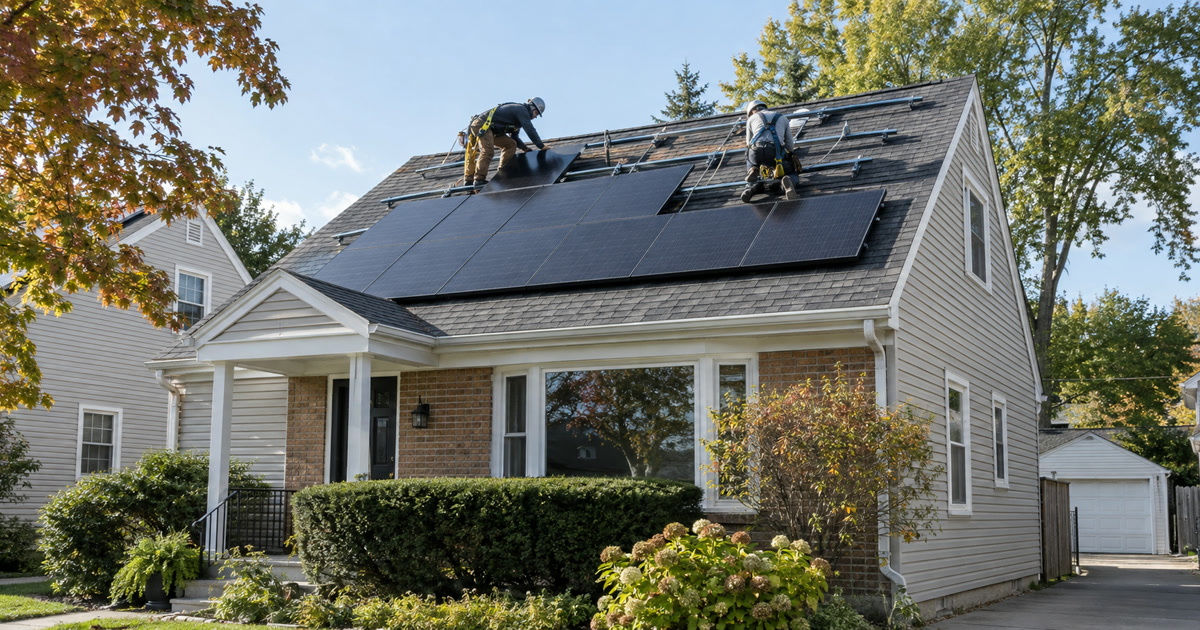
The ad appears in a social feed with a roof photo and a promise that the government will pay for solar panels. The claim is usually too broad, but it is loosely based on a real Illinois program.
Illinois Solar for All can support rooftop or community solar for income-eligible households. It requires meaningful savings and, for qualifying small residential projects, no upfront cost before the system is energized. It does not hand free panels to every Illinois homeowner, and participation depends on income verification, an eligible project, an approved company, available funding, and program approval.
What Illinois Solar for All is
Illinois Solar for All, commonly shortened to ILSFA, is administered by the Illinois Power Agency. The program was created under the Future Energy Jobs Act and expanded through later Illinois energy legislation to bring solar benefits to income-eligible households and eligible nonprofit and public facilities.
Like Illinois Shines, ILSFA uses contracts for Renewable Energy Credits, or RECs, generated by qualifying solar projects. The REC incentive is paid to the Approved Vendor under the program contract. The participant receives value through the solar offer, which must meet the program's savings and consumer-protection requirements.
The program includes Residential Solar for one-to-four-unit buildings, Residential Solar for buildings with five or more units, Community Solar, and a track for eligible nonprofit and public facilities. This guide focuses on the small residential track and the community solar option most relevant to individual households.
Who qualifies in 2026
For residential and community solar, household income generally cannot exceed 80% of the area median income for the county and household size. The number is updated annually and varies substantially across Illinois. Effective June 1, 2026, for example, the maximum for a two-person household in Cook, DuPage, Kane, Lake, McHenry, and Will counties is $77,800. Other counties use different limits.
Use the program's official income-eligibility tool rather than a statewide rule of thumb. The tool asks for county, household size, and gross household income.
Some households can verify eligibility through recent participation in a qualifying program. The current manual lists programs including SNAP, LIHEAP, Medicaid, Illinois' low-income utility discount rates, IHWAP, TANF, AABD, and certain HUD project-based assistance. Income verification can also use tax transcripts or other program-approved methods.
Renters are not limited to waiting for a landlord to install panels. Income-eligible renters and homeowners can join an eligible community solar project in their utility territory without putting panels on the property. Owners of one-to-four-unit buildings can pursue onsite residential solar when the household, property, and participant requirements are satisfied.
What “free” actually means
For the Residential Solar (Small) program, eligible households in one-to-four-unit buildings must have no upfront costs before project energization. That is the strongest accurate version of the “free solar” claim.
No upfront cost does not necessarily mean no cost of any kind. Depending on the ownership and contract structure, a participant may have ongoing payments or fees. The 2026-27 program rules require estimated participant savings of at least 50%: ongoing costs and fees generally cannot exceed half of the estimated value of the electricity produced for the participant, measured in the first year and over the agreement term.
That rule does not mean the entire utility bill is guaranteed to fall by 50%. Fixed charges, energy not offset by solar, rate changes, low-income discount interactions, system performance, and contract terms all affect the bill. The program itself warns companies not to market ILSFA as “free solar panels” or promise a 50% reduction in the whole electric bill.
The official Disclosure Form must show the system, ownership structure, costs, fees, warranties, estimated energy value, and projected savings. Residential participants also have 14 calendar days after signing the contract to cancel without penalty.
Where the “free solar” ads come from
Many ads start with the real no-upfront-cost rule and remove the income, vendor, funding, and approval conditions. Some are simply lead-generation forms that send a phone number to multiple sales companies. The safest check is whether the company names Illinois Solar for All, verifies eligibility before presenting the program as available, and appears in the official Approved Vendor Directory.
Approved Vendors can work with registered Designees that perform sales, marketing, installation, or other services. The Approved Vendor remains responsible for the program application and REC contract. Ask for the legal name of the Approved Vendor that would submit the project and verify both the company and its role in the directory.
How the process works
Start with eligibility. An Approved Vendor or the program verifies household income using an approved method. The company then evaluates site suitability, designs the system, provides the required Disclosure Form and contract, and submits the project during an applicable program window.
For the 2026-27 program year, the initial Residential Solar (Small) submission window ran from September 14 through September 25, 2026. The program says a rolling window will open October 12 if funding remains. Projects in that rolling window are considered first-come, first-served until the program year ends or the remaining budget is exhausted. Eligibility alone does not reserve funding or guarantee approval.
After approval, the normal project steps still apply: final design, permits, utility interconnection, installation, inspection, and permission to operate. The Approved Vendor handles the ILSFA filings and must document completion before the REC contract payment process can proceed.
How the savings requirement works on the bill
A 2026 ILSFA rooftop system uses the same applicable utility billing rules as another new solar system in that service territory. Electricity used by the home while the panels are producing reduces grid purchases. Eligible excess generation receives the credit provided under the customer's utility and supply arrangement. Our net billing guide explains the current ComEd structure.
The Disclosure Form calculates the estimated value of electricity and the participant's costs under standardized program rules. The Approved Vendor's offer must meet the minimum savings requirement, but actual bills can differ because weather, usage, rates, low-income discounts, outages, and system performance change over time.
That is why the Disclosure Form matters more than a generic monthly-savings claim. Compare the projected production, estimated energy value, regular payments, escalation rate, transfer terms, warranty, maintenance responsibility, and end-of-term ownership in one place.
Illinois Solar for All versus Illinois Shines
The programs use a similar REC mechanism but serve different markets. Illinois Shines supports qualifying solar projects broadly and uses standardized disclosures and registered Approved Vendors. The customer's REC benefit can appear as a project-price reduction, payment, or another contractual value depending on the agreement. Our Illinois Shines explainer covers the current REC prices and payment structure.
Illinois Solar for All uses higher REC incentives and additional savings requirements to serve income-eligible households and eligible organizations. The Approved Vendor receives the program incentive and the participant cannot also sell the same RECs. In return, the offer must meet ILSFA's no-upfront-cost and savings rules where applicable.
If a household does not qualify for ILSFA, Illinois Shines is one possible path, and utility incentives may still affect a standard purchase, loan, lease, or power-purchase agreement. Our Illinois solar cost guide explains how to compare those options without counting an expired residential federal credit.
What to do next
Check the official eligibility tool first. If the household appears eligible, contact companies through the program's directory and ask which Approved Vendor will submit the project, whether funding is available, what ownership model is proposed, and what every line of the Disclosure Form means. Do not provide sensitive income documents to a lead form that cannot identify its program role.
If you do not qualify or want to compare ILSFA with a standard Illinois solar proposal, schedule a free consultation. Direct Solar Pros is not the Illinois Power Agency and does not determine ILSFA eligibility or project approval. An ILSFA project must be submitted through an Illinois Solar for All Approved Vendor.
Program details checked September 28, 2026. Income limits, submission windows, funding, approved companies, utility rules, and program requirements can change. Confirm current information with Illinois Solar for All before relying on any figure or availability statement.
Frequently asked questions
Who qualifies for Illinois Solar for All?
For residential and community solar, an income-eligible household generally must have gross income at or below 80% of the area median income for its county and household size. Current thresholds vary by county and are updated annually. Participation in qualifying programs such as SNAP, LIHEAP, Medicaid, or certain housing-assistance programs may provide another verification path.
Are solar panels really free in Illinois?
Illinois Solar for All requires eligible Residential Solar (Small) participants in one-to-four-unit buildings to have no upfront costs before energization. A contract can still include ongoing costs, but program rules generally require those costs and fees to stay below 50% of the estimated value of the electricity generated. That is not the same as a guarantee that the entire utility bill will fall by 50%.
Does Illinois Solar for All cover renters?
Renters generally cannot install rooftop solar without the property owner, but income-eligible renters can participate in qualifying Illinois Solar for All community solar projects. Owners of one-to-four-unit rental properties may pursue the residential program when the applicable household, property, and participant requirements are met.
What is the difference between Illinois Solar for All and Illinois Shines?
Illinois Shines supports qualifying projects broadly through Renewable Energy Credit contracts. Illinois Solar for All uses higher REC incentives and additional consumer protections to serve income-eligible households and eligible public or nonprofit facilities. The customer benefit, ownership structure, and payment terms must be stated in the applicable disclosure form and agreement.
How do I apply for Illinois Solar for All?
Start with the official income-eligibility tool and the Illinois Solar for All Approved Vendor Directory. An Approved Vendor verifies eligibility, prepares the disclosure and contract documents, and submits the project during an available program window. Funding and capacity are limited, so eligibility does not guarantee project approval.